Electric rice cooker

September 3, 2026 Stories
I stumbled upon this rice cooker on the streets of St. John's, Newfoundland, left outside in working order for whoever might want it. I stopped to examine it. It was almost exactly like the one my family had bought in Hong Kong nearly fifty years earlier. I was “made in China” in the 1970s, when the country was still in the midst of the Cultural Revolution, which left it in disarray and impoverished. My peasant family was able to escape our destitution to a better life in Canada in 1979 thanks to its family reunification programme. Relatives who ran successful businesses in Toronto’s Chinatown sponsored us. Without them, we would not have qualified to enter Canada, which largely selects its immigrants through a points-based system. When we emigrated from Canton (Guangzhou), our first port of call was Hong Kong (which back then was a British colony). This was, de facto, the only point of travel connecting China with the West at the time. It was there that we also first encountered the modern world, and my family took advantage of this to buy the iconic white National/Panasonic electric rice cooker. Until then, we had previously prepared rice in our village…

Returning to Aawu (Yahucun)

August 1, 2026 Stories
As I sat with my wife on the stone bench in front of my childhood home in the village of Aawu (鴉湖村), an elderly lady walked by us and without pausing asked if I was the boy from that house who left nearly fifty years ago. She finally stopped fifteen metres away below the arch at the front of the laneway to rest by the entryway shrine. I followed her there and confirmed that I am indeed that boy and we quickly slipped into conversation in our Aawu dialect (countryside Cantonese), which instantly gave us a connection. I explained the reason for my return to the village. I had never visited my grandfather’s grave. Nor had I fulfilled another Cantonese obligation: Introducing my wife to him. With the extra fear of the village disappearing due to rapid urbanisation, I had finally returned to Maaubou (茅㘵, a neighbourhood within Aawu) to fulfil my duties. As we spoke, an elderly gentleman walked by and he too without stopping remarked as he strode past us, “I remember Kai. He would always say ‘tomorrow’ whenever we asked him when he would be moving to Canada.” The lady laughed and confirmed the story. Over the…

Grandpa Kai

June 21, 2026 Stories
When I was a child in Maaubou, I caught shrimps from the village pond and carried home fish when it was drained for harvest. When I returned to my village, I strolled by the pond and sought the space in front of the Chan Ancestral Hall where I had played as a child. By the benches there under the banyan tree I saw a gathering of elderly residents. As I made my way to them, I was warmly greeted as they recognised me. We had a lively conversation in our Aawu dialect. One elder laughed and asked how a man who left at age four could still speak the dialect. Another asked whether my siblings and cousins in Canada still spoke it. To their amusement, I even got my wife to sing in the local dialect a childhood nursery rhyme that I taught her. All were pleasantly surprised that I proudly retained the dialect after almost fifty years. I explained that I spoke with my parents exclusively in dialect growing up. However, their astonishment is not without merit. Over the years, standard Cantonese and then Mandarin have overtaken the area as the village urbanised and migrants from other parts of…

One more meal with grandpa

June 19, 2026 Stories
The most vivid memories of my childhood in China are those sharing food with my grandfather. China was poor in the 1970s. Food was scant and meat a luxury. One poignant recollection is when my grandfather cooked game that he caught in the rice fields and shared that tasty meal with me. I also remember when he would offer me biscuit, quietly slipping it to me when the other kids weren’t looking. I last saw my grandfather when I was four — almost fifty years ago — just before my family emigrated to Canada. He died shortly after we left the village. For reasons largely beyond my control, I had never visited my grandfather’s grave. Nor had I fulfilled another Cantonese obligation: Introducing my wife to him. Relatives would prod me: “You were his favourite. You must go visit his grave.” With the extra fear of my village disappearing due to rapid urbanisation, I finally returned to Maaubou a few weeks ago and reconnected with family who stayed behind. I had not spoken with my paternal cousins in over twenty years. We were seven children — my two siblings, four cousins, and me — living under the same roof with…

Tomorrow 50 years later

June 18, 2026 Stories
As I sat with my wife on the stone bench in front of my childhood home in the village of 𝐴𝑎𝑤𝑢 (鸦湖 = “Crow Lake”), an elderly lady walked by us and without pausing asked if I was the boy from that house who left nearly fifty years ago. She finally stopped 15 metres away below the arch at the front of the laneway to rest by the entryway shrine. I followed her there and confirmed that I am indeed that boy and we quickly slipped into conversation in our 𝐴𝑎𝑤𝑢 dialect (countryside Cantonese), which instantly gave us a connection. As we spoke, an elderly gentleman walked by and he too without stopping remarked as he strode past us, “I remember Kai. He would always say ‘tomorrow’ whenever we asked him when he would be moving to Canada.” Over the years, several other residents of 𝑀𝑎𝑎𝑢𝑏𝑜𝑢 (茅㘵 = “Reed Field”; a neighbourhood within 𝐴𝑎𝑤𝑢), have told me the same story. Apparently, as a child I was quite loquacious and would go around greeting all the households in the laneways connected to 𝑀𝑎𝑎𝑢𝑏𝑜𝑢 Street. When news came about that my family would be moving to Canada, all the people of 𝑀𝑎𝑎𝑢𝑏𝑜𝑢…

Carlaw doughnut shop

August 2, 2025 Stories
The Jamaican beef patty is a Toronto staple food. I have many fond memories of how it played a big part of and enriched my life. I grew up during the ‘80s and ‘90s in Leslieville/ South Riverdale before it got gentrified. My go-to place for beef patties back then was Donut Express on the northwest corner of Carlaw Ave and Gerrard Street East, just a few blocks from my childhood home (and where my parents still live). Unfortunately, it closed many years ago, but I still fondly reminisce about their patties. I left Toronto in 1999. When I go back to visit, the Jamaican beef patty is on my list of obligatory Toronto foods to indulge in (along with ketchup chips, butter tarts, bloody Caesars, and siu mei (Cantonese BBQ)). Donut Express was an unpretentious 24/7 doughnut shop that was popular with working-class folks and sleepless youths looking for a place to pass the night. Most notably, the establishment had a video poker machine adjacent to their food counter (where the patties were made/served), and a jukebox with a selection of music from that era. As a teen and young adult, I worked late at a restaurant job. Therefore,…

Duk Shing coffee shop

June 6, 2025 Stories
Back in the early 1990s, I used to frequent a coffee shop in East Toronto which was a popular hangout for troublemaker teens. It was a bit of a lawless place. Illegal cigarettes were sold under the counter and there were constant rumours of gambling on site. The air inside was always thick with smoke as it was a popular place for delinquent students to take their cigarette breaks. I had a few memorable incidents at this establishment, which made me well known to the proprietor and the regulars. I first gained notoriety at Duk Shing when I — at the time totally removed from the miscreant scene — went inside the shop to confront a group, led by "Big Brother", that had been “rolling” my friends (i.e. robbing via threat of assault). The plan was for my friends and I to confront BB inside Duk Shing and make it known that we would not be pushed around. A rival faction, who had their own beef with the group and was friendly with us, waited outside in full view from inside the shop as our backup. I had hitherto never entered Duk Shing, but mustered the courage to take a…

Dining in Strachan Hall

May 2, 2025 Stories
My mum used to collect vegetables tossed in the dumpster of a wholesale produce warehouse near our home. I also used to go to my sister's workplace, a flower shop in Toronto's financial district, and collect the carcasses of chickens in a large black plastic bag from an adjacent fried chicken takeaway shop to cook at home. These were done for practical reasons, rather than necessity, but they coincided with the worst of my family’s financial hardship back in the 1990s. The vegetables that my mum collected were fine to consume. If they were leafy greens, such as cabbage, we would just peel off the top rotten layers. Else we would simply chop off the bad parts. Likewise, the chicken carcasses were freshly cut and of good quality. There was still plenty of meat on them. My sister knew the butcher at the chicken shop, and they would otherwise be tossed out. In my first year at Trinity College (University of Toronto), I used to "sneak" into the posh resident dining hall (where students were required to wear a black academic gown to dine and meals were served by waitstaff). I was a non-resident at Trinity and non-res students were…

Hsin Kuang Restaurant

April 7, 2025 Stories
My father built the Hsin Kuang chain of restaurants in Toronto. It was a high-profile brand from Hong Kong, and when it was introduced to Toronto in the 1980s it made a splash in the local community. Its flagship location was on 346 Spadina Ave in Toronto’s downtown Chinatown. It was notable for its bright yellow and green Chinese architecture. The brand is no longer around. The Hsin Kuang on Spadina later became the Bright Pearl in 1997. In 2018, 346 Spadina was demolished and replaced by a condominium/ office complex. There are many intriguing stories about the old Hsin Kuang Restaurant building on Spadina, including tales of it being haunted. Prior to it being a restaurant, it served at one point as a funeral parlour. Stories abound of mysterious knocks on the bathroom stalls, or of sightings of a female floating around the restaurant. My dad once had an employee who was too scared to work there on night shifts when it was under construction. He had to threaten to fire him to get him back on task. Some people assume that my family must have been doing well financially given that my father was the contractor that built…

INSEAD

January 1, 2025 Academics, PROFESSIONAL
I was a Distinguished Fellow at INSEAD (Innovation & Policy Initiative) at the Abu Dhabi campus from 2015-19. In that role, I collaborated on scholarly research and supported the institution's academic commitments. INSEAD bio: Dr Kai L. Chan Distinguished Fellow, INSEAD Innovation & Policy initiative Dr Kai L. Chan is a Distinguished Fellow at INSEAD Innovation and Policy Initiative. He is also part of the senior management team of a Montreal-based technology (cloud software) company. Previously Dr Chan was a special adviser to the UAE federal government on competitiveness and statistics, where he focused on that country's positioning on global performance indices. He was also a member of the Dubai Expo 2020 bid team. Prior to moving to the UAE in 2011, Dr Chan served as an associate and the in-house economist for a consumer finance merchant banking firm in Manhattan. Before that, he worked in the Singapore office of a global management consulting firm with assignments in Asia and Europe covering risk management and strategic planning for banks. Dr Chan’s expertise/research cover education, income distribution, migration, government & policy, and performance measurement. He is the creator of the Power Language Index, Gender Progress Index, and Intelligence Capital Index. His works…

Welcome!

Archives:

Categories

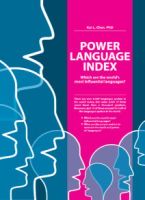
These are the world’s most powerful languages:

Research Documents (pdf)

Intelligence Capital IndexPower Language IndexImmigrating into the workforceCanada's Mosaic Ceiling

Presentations (pdf):